

About Murchison Falls National Park: Located in the northwest of the nation, Murchison Falls National Park is the oldest protected region in the country. The name of Murchison Falls National Park was formerly Kabalega National Park, and it had been there for a long time. The park was given the name Kabalega National Park in honor of the king of Bunyoro at the time. Sir Samuel Baker found the Kabalega Falls during his trip to the national park in 1864, and he gave them the name Murchison Falls.
From that point on, the national park’s name changed from Kabalega National Park to Murchison Falls National Park, but during the time of Idi Amin Dada, he ordered the national park to be named Kabalega National Park. By then, the differences between Africans and Westerners were to blame for this. The national park was known as Murchison Falls National Park up until Idi Amin Dada’s reign.
Reaching Murchison Falls National Park
The northwestern area of Uganda is home to the Murchison Falls National Park, which is split across four districts: Buliisa, Nwoya, Kiryandongo, and Masindi district. In a single day, it may be reached by air or road. Depending on which side of the national park you intend to visit, you may reach it from Kampala by road transport via Luwero and Nakasongola to Masindi or Pakwach.
You still need to reserve your seats three to four months in advance to avoid any disruptions when traveling by air to this park. The journey to Murchison Falls National Park begins at either Entebbe International Airport or Kajjansi Airstrip, and it ends at Chobe Airstrip and Pakuba Airstrip on the northern side of the park or Bugugu Airstrip on the southern side.
The climate and weather
Every year, this park goes through two dry and two rainy seasons. It is said that the ideal time to visit the park is during the dry season, which runs from June through September and December through February, since there is little to no rain, which keeps the game vehicles dry and the vegetation low, allowing for clear views of the wildlife.
Although the park is always open, the rainy season, which lasts from March to May and October to November, is not the ideal time to come. Tourists may always visit the park, but budget tourists gain since they receive significant savings on lodging options. With a lot of rain, the rainy season makes the game trucks muddy and slick, makes the roads leading to the park impassable, and has high vegetation that obscures the views of the animals.
Murchison falls national park’s attractions
Murchison Falls
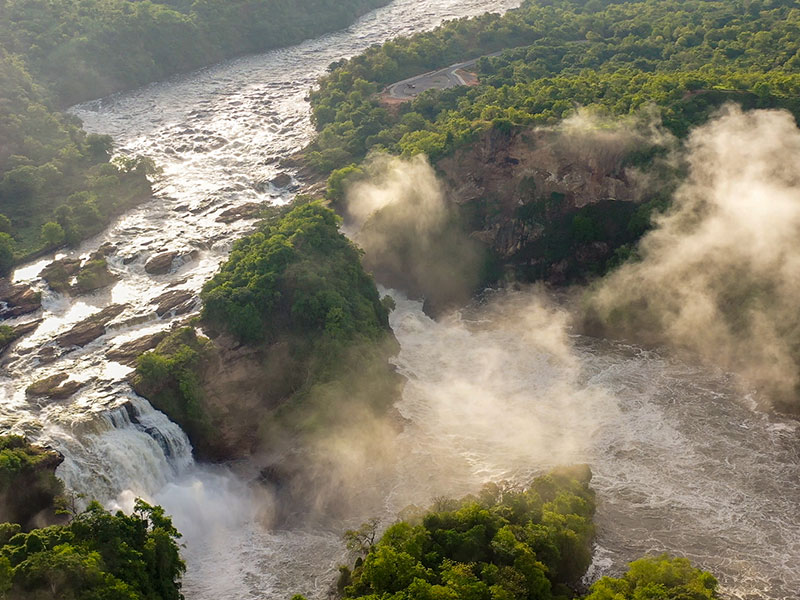
One of the attractions in this park, located on the River Nile, is Murchison Falls. The national park bears the name of the Murchison Falls, which were found by Sir Samuel Baker. The Murchison Falls are the most powerful falls in the world, and they do draw a large number of visitors to the park.
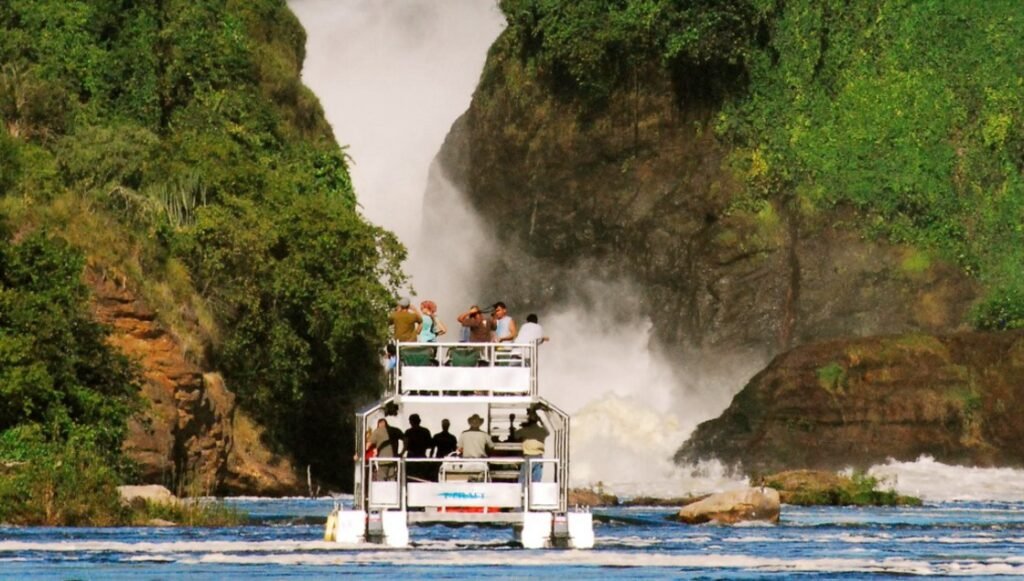
Many tourists that come to Murchison Falls National Park wish to see the falls, and they can do so by either hiking to the top or taking a boat excursion to the base of the falls. The best way to view the Murchison Falls is by hiking to the summit of the falls, as tourists can see the water coming at a great speed, pass through a narrow canyon, and then fall 40 meters into a pool, resulting in the Murchison Falls.
Birds
With over 451 different bird species documented there to date, the park is among the top locations in the nation for birdwatching. The several habitats of Murchison Falls National Park, which includes riverine, woodland, and savanna vegetation, support a variety of bird species. The birding is guided, and although it can still be done while on game drives and boat excursions, nature walks are the way to go.
Birds in Murchison Falls National Park include the red-throated bee-eater, bar-breasted firefinch, grey-headed bush shrike, African darter, silver bird, chestnut-crowned sparrow weaver, Vaseline-masked weaver, piapiac, whistling cisticola, common teal, white-rumped seedeater, pied kingfisher, blue-naped mousebird, red-winged grey warbler, rock pratincole, black-headed batis, black-headed gonoleck, double-toothed barbet, and yellow-throated leaf love.
Additional bird species found in this park include the northern carmine bee-eater, black-lored babbler, fawn-breasted waxbill, spotted Verreaux’s eagle-owl, blue-napped mousebird, giant kingfisher, white-bellied night heron, Eurasian harrier, Cassin’s spine tail, rock pratincole, swallow-tailed bee-eater, pied kingfisher, Egyptian geese, palm nut vulture, African shrike-flycatcher, pygmy crake, African jacana, and chocolate-backed kingfisher.
Mammals
Murchison Falls National Park is home to more than 76 species of mammals, which may be observed during boat trips, nature hikes, and game drives. Since the park has food all over, the animals may be found there. Taking a game drive activity, in which you visit various sections of the park in search of different creatures, is the best way to observe them.
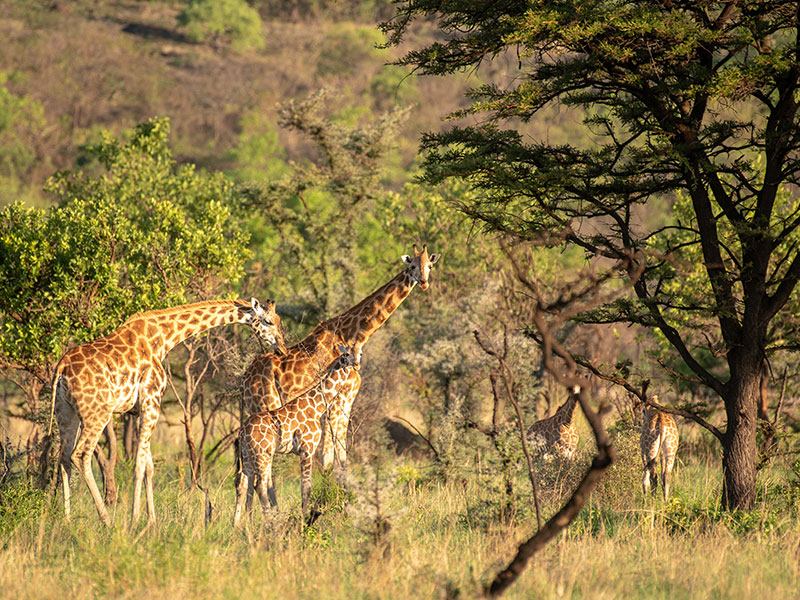
Tourists are able to see as many animals as possible during the game drives, which take place in the morning, evening, and nighttime. Tourists can see creatures during the game drives like lions, buffaloes, duikers, Jackson’s hartebeests, lions, leopards, bushbucks, Uganda kobs, giraffes, elephants, dik-diks, reedbucks, hippos, waterbucks, topis, and oribis, among many others.
Primates
The thirteen primate species that have been documented in Murchison Falls National Park are best observed in Budongo Forest, which is located in the southern part of the park. Although there are just nine primate species in Budongo Forest, you may see some of them while participating in activities in Murchison Falls National Park.
Additional primates.
Chimps are the only one of the 13 primates that have been habituated and are receptive to trekking. The primary activity conducted in Budongo Forest is chimpanzee trekking, but tourists can also spot a variety of mammals during the search, such as red-tailed monkeys, blue monkeys, black and white colobus monkeys, patas monkeys, olive baboons, and grey-checked mangabeys, among others.
Nile River
The Nile is the longest river in the world, and Lake Victoria is considered to be its origin. The River Nile begins at Lake Victoria, where it discharges its water into the Mediterranean Sea, but as it flows, it passes through Lake Kyoga, then through Murchison Falls National Park, before arriving at Lake Albert, which is located west of the park.
A boat trip is always available for visitors to explore the River Nile in Murchison Falls National Park. The river excursion may go to the Nile delta if you want to see Lake Albert or to the base of the falls if you want to see Murchison Falls. Tourists may see a variety of species on the River Nile during any of the boat trips, including hippos, crocodiles, water birds, and various park animals along the riverbanks.